If the power grid fails, how far will you go to survive?
After the EMP
Madison spends her days tending plants as an agriculture student at the University of California, Davis. She plans to graduate and put those skills to work only a few hours from home in the Central Valley. The sun has always been her friend, until now.
When catastrophe strikes, how prepared will you be? Tracy starts her morning like any other, kissing her husband Walter goodbye before heading off to work at the local public library. She never expects it to end fleeing for her life in a Suburban full of food and water. Tackling life’s daily struggles is one thing, preparing to survive when it all crashes down is another.
The end of the world brings out the best and worst in all of us.
With no communication and no word from the government, the Sloanes find themselves grappling with the end of the modern world all on their own. Will Madison and her friends have what it takes to make it back to Sacramento and her family? Can Tracy fend off looters and thieves and help her friends and neighbors survive?
The EMP is only the beginning.
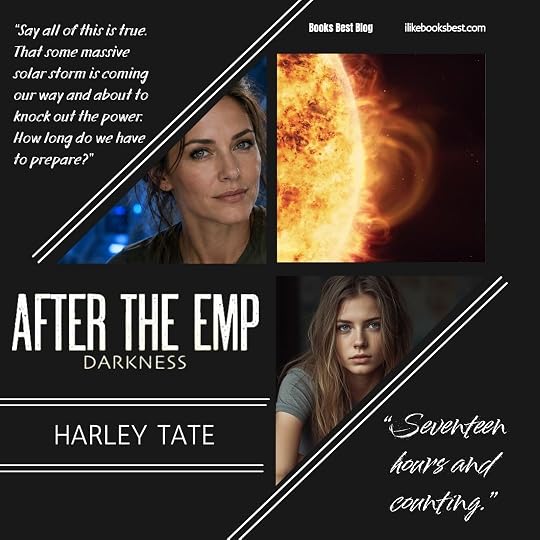
The Darkness Trilogy (Books 1-3 in After the EMP) follows the Sloane family as they attempt to survive after a geomagnetic storm destroys the nation’s power grid.
No Power, No Safety, No Easy Way Home
The following ratings are out of 5:
Story/Plot: 📕📗📙📘
World building: 🌏🌍🌎🌏
Character development: 😋😉😎😮
Narration: 🎙🎙🎙🎙🎙
Narration Type: Dual Narration
Characters and Plot Summary
I love a good post-apocalyptic survival story, especially when it takes ordinary people and forces them to figure out what they are capable of when the world they know disappears overnight. Darkness follows the Sloane family through the terrifying aftermath of a geomagnetic storm that destroys the nation’s power grid, leaving people without electricity, reliable communication, or any certainty about what comes next.
Madison Sloane is an agriculture student at the University of California, Davis, looking forward to a future that suddenly seems very far away. When the disaster strikes, she is separated from her family and has to find a way back to Sacramento with her friends. I liked that Madison’s agricultural background gives her some useful knowledge in a world where food and other basic necessities are becoming increasingly important, but knowing a little about plants is very different from navigating a society that is rapidly falling apart.
Her mother, Tracy, has a completely different set of problems. Tracy works at the local public library and begins the story expecting an ordinary day, including saying goodbye to her husband, Walter, before he leaves for work. Instead, she finds herself fleeing danger in a Suburban loaded with food and water, trying to protect herself and the people around her. Walter, meanwhile, is caught away from home when the power fails. As an airline pilot, he has to deal with the consequences of the disaster while trying to make his way back to his wife and daughter.
The three books follow the family’s struggle to reunite and survive as the situation becomes more dangerous. Getting home is only the beginning. Once Madison returns to Sacramento, the Sloanes must contend with desperate neighbors, looters, dwindling security, and the difficult question of whether staying put is safer than leaving. By the third installment, the family is considering a move toward a more remote location, including a cabin that offers the possibility of greater safety.
What makes their situation frightening is that the immediate disaster is only part of the problem. With no dependable government assistance or communication, the family cannot know whom to trust or how bad things will become. Their biggest challenge is learning that surviving the collapse of modern conveniences is one thing, but surviving other people can be something else entirely.
Highlights and Limitations
My favorite aspect of this trilogy is the family-centered approach to the apocalypse. Madison is trying to get home, Tracy is trying to hold things together, and Walter is desperately trying to return to his family. Their separate journeys make the reunion feel like something worth rooting for rather than just another milestone in a disaster story.
I also appreciated how the danger evolves. The initial power failure creates uncertainty, but that uncertainty gradually turns into a fight over supplies, safety, and trust. The Sloanes’ attempts to protect what they have, only to discover that their home and provisions cannot guarantee their security, make the survival stakes feel personal. I found the contrast between preparing for a disaster and actually living through one particularly effective.
The moral decisions are another strong point. Madison’s willingness to consider helping strangers, even when doing so could put her own group at risk, highlights the tension between compassion and self-preservation. I understand the impulse to help, but I also caught myself wishing she would sometimes think through the danger a little more carefully. In a world where one bad decision can cost everyone their lives, good intentions are not always enough.
That said, some character decisions and dialogue felt a little too convenient or heavy-handed for my taste. The story occasionally spells out its ideas rather than letting the situations speak entirely for themselves. Madison’s repeated struggle over whether to help people can also feel familiar by the third book, and I would have liked a little more variation in how those ethical dilemmas developed.
Still, the straightforward writing keeps the story moving, and having all three books together makes it easy to continue with the Sloanes without stopping just when things get complicated.
Narration
The audiobook benefits from having Cassandra Campbell, Kevin Pierce, and Gabra Zackman sharing the performance. With three narrators, the story has room for different perspectives as Madison, Tracy, Walter, and the people around them deal with the consequences of the EMP.
Cassandra Campbell brings a clear, engaging delivery to the story, while Kevin Pierce is a natural fit for the gritty atmosphere of post-apocalyptic survival fiction. Gabra Zackman adds another voice to the ensemble, helping distinguish the different viewpoints. I particularly appreciate multiple narrators in a story like this because the characters are scattered across different locations, facing different dangers, and making their own decisions before their paths come together.
The production runs just over sixteen hours, making this a substantial listen. The narration helps maintain the momentum across all three books, although the straightforward writing means the performance has to do some of the work of keeping quieter stretches engaging.
Final Thoughts
Overall, I enjoyed the premise of Darkness and the focus on the Sloane family trying to stay together when practically everything they depend on has disappeared. Madison, Tracy, and Walter each face different challenges, and I liked seeing how the same catastrophe affects them in different ways. Tracy’s determination to protect herself and those around her especially appealed to me, because she is forced to adapt quickly rather than wait for someone else to solve the problem.
I also liked that the trilogy doesn’t treat reaching safety as a simple solution. The family can make plans, gather supplies, and try to find a secure place to live, but they cannot control how other people will react when resources become scarce. That uncertainty kept me interested in what would happen next. Books like this sure make you think about how you would survive if something ended life as we know it. I know I only ever have enough groceries for about 2 weeks on hand, and more often than not, much less than that. If you count the fact that electricity may no longer work, much of my groceries would go bad and I would soon starve. It also always surprises me at how quickly other people become the big bad in the world.
I would have preferred a little more nuance in some of the character interactions and fewer moments when the same moral questions resurfaced without much development. Even so, the central family struggle kept me invested, and having all three installments in one audiobook makes this a convenient choice for anyone who enjoys following a survival story over an extended stretch.
For fans of EMP fiction, family survival, and post-apocalyptic stories where the greatest threat may come from other survivors, this trilogy is worth considering. It isn’t perfect, but the Sloanes’ fight to find one another and build some kind of future after the collapse gave me enough reason to keep listening.

