For We Are Many by Dennis E. Taylor
My rating: 5 of 5 stars
Bob Johansson didn’t believe in an afterlife, so waking up after being killed in a car accident was a shock. To add to the surprise, he is now a sentient computer and the controlling intelligence for a Von Neumann probe.
For We Are Many
Bob and his copies have been spreading out from Earth for 40 years now, looking for habitable planets. But that’s the only part of the plan that’s still in one piece. A system-wide war has killed off 99.9 percent of the human race; nuclear winter is slowly making the Earth uninhabitable; a radical group wants to finish the job on the remnants of humanity; the Brazilian space probes are still out there, still trying to blow up the competition; and the Bobs have discovered a spacefaring species that sees all other life as food.
Bob left Earth anticipating a life of exploration and blissful solitude. Instead he’s become a sky god to a primitive native species, the only hope for getting humanity to a new home, and possibly the only thing that can prevent every living thing in the local sphere from ending up as dinner.
So Many Bobs, So Many Problems, So Much Fun
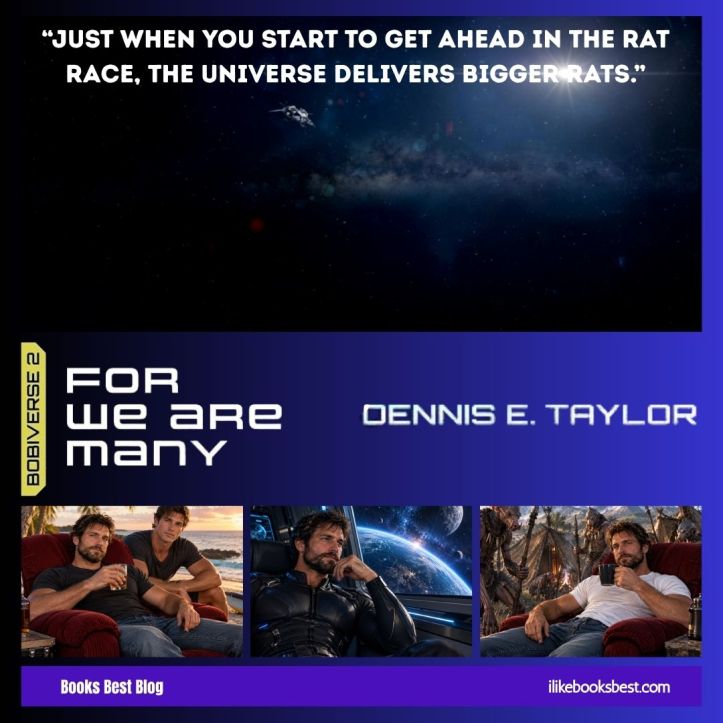
The following ratings are out of 5:
Story/Plot: 📕📗📙📔📘
World building: 🌏🌍🌎🌏🌍
Character development: 😋😉😎😮😍
Narration: 🎙🎙🎙🎙🎙
Narration Type: Solo Narration
Characters and Plot Summary
For We Are Many picks up right where the first Bobiverse book left off, and listening to it felt like dropping back into a sprawling, chaotic family reunion where everyone is technically the same person. Bob Johansson and his many copies are scattered across the stars, each pursuing wildly different missions. Bob‑1 continues watching over the Deltans, a primitive but intelligent species struggling to survive on a world filled with multiple apex predators. One moment that stuck with me was when Bob‑1 discovered the camouflaged flying creatures that kept attacking the Deltans. When a flock of them assaulted the village of Camelot, Bob‑1 used a kinetic strike to destroy their rookery. It solved the immediate problem, but the Deltans were so terrified by the destruction that they banished him. I felt genuinely sad for Bob‑1 as he watched Archimedes grow older from afar, unable to interact with the friend he had nurtured since childhood.
Meanwhile, other Bobs are dealing with humanity’s messy exodus from Earth. The colony ships are ferrying ten thousand people at a time toward Vulcan, a planet with its own dinosaur‑like predators. The Bobs stationed near Earth are trying to keep fifteen million survivors alive long enough to board those ships, all while fanatics sabotage food supplies and kill livestock. I found myself tense during the scenes where VEHEMENT attacked orbital farms and poisoned resources.
Mario’s storyline surprised me the most. He traveled far beyond the usual Bobiverse routes and stumbled upon planets stripped bare by an alien species that consumes all biological life and mines the world before moving on. The moment Mario connected to BobNet and warned the others felt like a turning point. Suddenly the Bobiverse wasn’t just about exploration or shepherding humanity. There was a real existential threat out there.
And then there is Madeiros, the Brazilian counterpart to Bob, who wants nothing more than to eliminate every Bob and similar entity. His presence adds a simmering tension to the background, reminding me that not all threats come from aliens or environmental collapse.
Highlights and Limitations
One of my favorite aspects of this book is how many Bobs are out there doing completely different things. It never felt repetitive. Bob‑1 is dealing with moral dilemmas about interfering with a developing species. Howard is helping humans settle on Vulcan while dodging hostile wildlife and political sabotage. Mario is investigating the Others. Bill is coordinating everything through SCUT. Even the smaller moments, like the Bob’s using GUPPI in the VR as the fishlike creature like Admiral Ackbar, gave the story personality.
The pacing worked for me because each storyline had its own stakes. I especially enjoyed the scenes where the Bobs debated how much they should intervene in human affairs. When Riker hunted down the VEHEMENT mastermind to get some well-deserved payback, I understood his anger even though the retaliation was brutal.
If I had one limitation to mention, it is that the sheer number of Bobs can occasionally make it hard to remember who is doing what. I never felt lost, but I did sometimes wish a few threads had more breathing room. Still, the variety is part of what makes the series fun.
Narration
Ray Porter continues to be perfect for this series. His ability to give each Bob a distinct personality without making them sound like caricatures is impressive. I especially liked how he handled the emotional beats with Archimedes and the tense moments on Vulcan. Porter’s delivery during Mario’s discovery of the Others made the threat feel genuinely ominous. His narration kept me fully engaged, and I ended up reading and listening to the first two books in a single day.
Final Thoughts
I loved this audiobook. The mix of humor, exploration, danger, and philosophical questions about identity kept me hooked from start to finish. The multiple Bob perspectives made the universe feel huge, and the stakes felt higher than in the first book. I plan to keep listening to the rest of the series over the next few days because I need to know how the Bobs handle the Others and what becomes of the colonies. If you enjoy character‑driven science fiction with big ideas and a lot of heart, this one is absolutely worth your time.
Blog|Goodreads|Facebook|Instagram|Pinterest|BookBub
View all my reviews

