The Correspondent by Virginia Evans
My rating: 5 of 5 stars
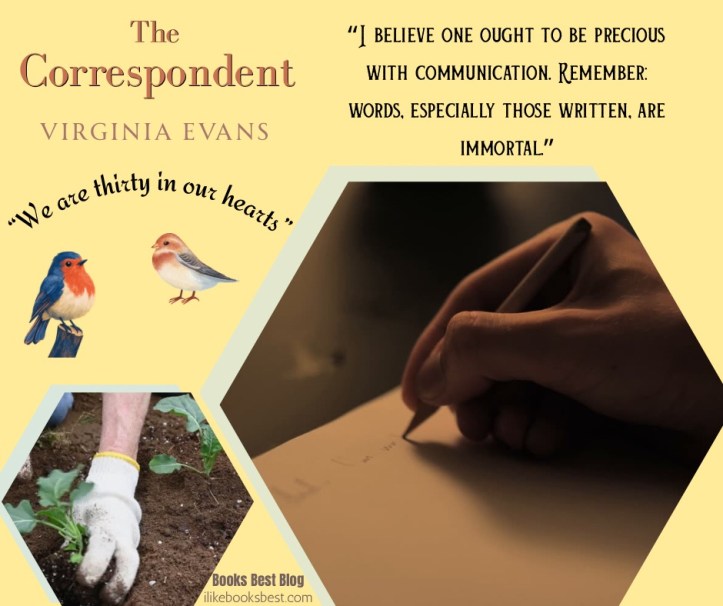
“Imagine, the letters one has sent out into the world, the letters received back in turn, are like the pieces of a magnificent puzzle. . . . Isn’t there something wonderful in that, to think that a story of one’s life is preserved in some way, that this very letter may one day mean something, even if it is a very small thing, to someone?”
The Correspondent
Filled with knowledge that only comes from a life fully lived, The Correspondent is a gem of a novel about the power of finding solace in literature and connection with people we might never meet in person. It is about the hubris of youth and the wisdom of old age, and the mistakes and acts of kindness that occur during a lifetime.
Sybil Van Antwerp has throughout her life used letters to make sense of the world and her place in it. Most mornings, around half past ten, Sybil sits down to write letters—to her brother, to her best friend, to the president of the university who will not allow her to audit a class she desperately wants to take, to Joan Didion and Larry McMurtry to tell them what she thinks of their latest books, and to one person to whom she writes often yet never sends the letter.
Sybil expects her world to go on as it always has—a mother, grandmother, wife, divorcee, distinguished lawyer, she has lived a very full life. But when letters from someone in her past force her to examine one of the most painful periods of her life, she realizes that the letter she has been writing over the years needs to be read and that she cannot move forward until she finds it in her heart to offer forgiveness.
Sybil Van Antwerp’s life of letters might be “a very small thing,” but she also might be one of the most memorable characters you will ever read.
One Woman’s Truth, One Letter at a Time
The following ratings are out of 5:
Story/Plot: 📕📗📙📔
World building: 🌏🌍🌎🌏🌍
Character development: 😋😉😎😮😍
Narration: 🎙🎙🎙🎙🎙
Narration Type: Full Cast Duet Narration
Characters and Plot Summary
Sybil Van Antwerp is the kind of character I immediately understood. She is a divorced mother and grandmother, a former lawyer, an avid reader, and, most importantly, a dedicated letter writer. Nearly every day, she sits at her desk corresponding with people in her life, from her brother Felix in France to her neighbor Theodore Leubeck and even authors whose books she admires. I particularly enjoyed seeing how different Sybil’s voice becomes depending on who is receiving her words.
There is also one letter Sybil has been writing for years but has never sent. That is where she is most completely honest. Sybil has been diagnosed with a condition that is slowly causing her to go blind, and she admits in this private correspondence just how frightened she is. After losing time while driving and crashing her Cadillac, she tells the truth about how disturbing the experience was, including her nightmares about being unable to see or write. Her ophthalmologist cannot tell her whether she has a year or ten years before her vision is gone.
Meanwhile, her children are beginning to make decisions about her future. When her daughter suggests that Sybil consider a nursing home near her son’s home, Sybil is furious. She has deliberately kept her financial situation private because she does not want money influencing how her children treat her. Her ex-husband gets cancer, and Sybil continues to grieve her son Gilbert who died when he was young.
There is also a more unsettling thread involving letters from a man identified only as D.M. He seems to despise Sybil and the judge she once worked for. His messages become increasingly menacing, including comments indicating that he has been to her home and noticed her garden and the value of her house. That element added a layer of tension to what otherwise feels like a very intimate portrait of an older woman’s life.
Highlights and Limitations
The correspondence format was easily my favorite part of this book. Listening to Sybil’s letters and emails made me feel as though I was getting pieces of her life directly from her rather than having everything explained to me by a narrator. I especially liked the contrast between the polished things she tells other people and the much more vulnerable truth she puts into the letter she cannot bring herself to send.
Her relationship with Felix also gave the story some wonderful personal details. She thanks him for his birthday card, talks about finally stopping the hair dye, updates him about her children and neighbors, and even remembers the day their parents brought Felix home from the orphanage, followed by her own memories of being brought home.
I also enjoyed Sybil’s history as a lawyer. After finishing first in her law school class, she eventually left private practice and became a clerk for Judge Guy D. Donnelly. When a journalist questioned why someone with her background would accept what was portrayed as a low-paying position, Sybil wrote back to correct the record. I liked that moment because it showed her pride and independence without requiring her to make a grand speech.
My biggest issue was the pacing. The beginning felt quite slow, and it took me some time to become familiar with all the people Sybil was corresponding with and understand how their stories connected to hers. Once I became invested in Sybil herself, though, I found the slower pace much easier to accept.
Narration
The full-cast narration was terrific and was a perfect match for this particular format. Having each correspondent read their own letters made the exchanges feel much more natural than if a single narrator had performed everything.
Maggi-Meg Reed’s portrayal of Sybil especially worked for me. Her voice captured the personality I imagined from the writing: an older, wealthy woman who can be somewhat uppity and particular, but who is also intelligent, emotional, vulnerable, and capable of genuine anger. Because the story depends so heavily on correspondence, giving the different writers distinct voices made a real difference.
Final Thoughts
This audiobook affected me more emotionally than I expected. So much of Sybil’s life is already behind her, and she is very aware that she is entering the later season of her life. Her fear of losing her eyesight, her memories of the past, her complicated feelings about her children, and her determination to remain independent all gave the story a melancholy quality that really stayed with me.
I found myself seeing parallels between Sybil’s thoughts about the passage of time and my own feelings about where I am in life, which made some of her private reflections surprisingly difficult for me to listen to. Her fear wasn’t simply about going blind. It was about losing the very things that made her feel like herself, particularly reading and writing.
This isn’t a fast-paced audiobook, and I would not recommend it to someone looking for constant action. For me, however, the intimate correspondence format and Sybil’s increasingly honest reflections made the slower pace worthwhile. By the end, I felt like I had actually gotten to know this complicated, intelligent woman, and that is what made the story memorable for me. It is one that will stick with you long after you finish.
Blog|Goodreads|Facebook|Instagram|Pinterest|BookBub
View all my reviews

