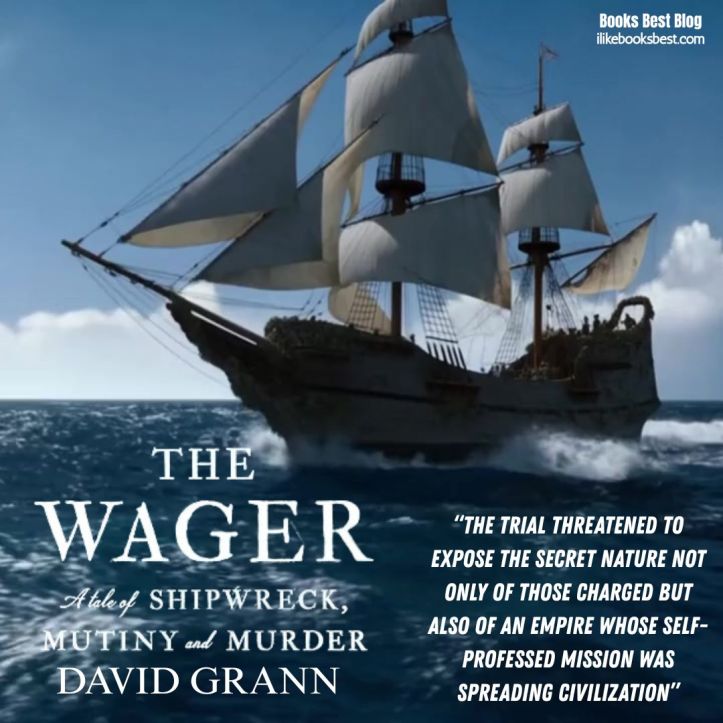
The Wager: A Tale of Shipwreck, Mutiny and Murder by David Grann
My rating: 4 of 5 stars
On January 28, 1742, a ramshackle vessel of patched-together wood and cloth washed up on the coast of Brazil. Inside were thirty emaciated men, barely alive, and they had an extraordinary tale to tell. They were survivors of His Majesty’s Ship the Wager, a British vessel that had left England in 1740 on a secret mission during an imperial war with Spain. While the Wager had been chasing a Spanish treasure-filled galleon known as “the prize of all the oceans,” it had wrecked on a desolate island off the coast of Patagonia. The men, after being marooned for months and facing starvation, built the flimsy craft and sailed for more than a hundred days, traversing nearly 3,000 miles of storm-wracked seas. They were greeted as heroes.
The Wager
But then . . . six months later, another, even more decrepit craft landed on the coast of Chile. This boat contained just three castaways, and they told a very different story. The thirty sailors who landed in Brazil were not heroes – they were mutineers. The first group responded with countercharges of their own, of a tyrannical and murderous senior officer and his henchmen. It became clear that while stranded on the island the crew had fallen into anarchy, with warring factions fighting for dominion over the barren wilderness. As accusations of treachery and murder flew, the Admiralty convened a court martial to determine who was telling the truth. The stakes were life-and-death–for whomever the court found guilty could hang.
The Wager is a grand tale of human behavior at the extremes told by one of our greatest nonfiction writers. Grann’s recreation of the hidden world on a British warship rivals the work of Patrick O’Brian, his portrayal of the castaways’ desperate straits stands up to the classics of survival writing such as The Endurance, and his account of the court martial has the savvy of a Scott Turow thriller. As always with Grann’s work, the incredible twists of the narrative hold the reader spellbound.
Shipwreck, Survival, and Shattered Loyalties
Character Backgrounds and Plot Summary
The Wager is nonfiction, but David Grann structures it with the tension and momentum of an adventure novel. Rather than centering on a single protagonist, the book follows a collection of officers, sailors, and survivors aboard the British warship HMS Wager during an eighteenth century naval expedition. Two of the most important figures are John Byron, a young midshipman who later became grandfather to poet Lord Byron, and Captain David Cheap, the rigid and increasingly controversial officer who assumes command after disaster strikes. Grann also spends time on ordinary seamen who had little social standing but whose experiences reveal the brutal realities of naval life.
The story begins with Britain’s attempt to challenge Spain during the War of Jenkins’ Ear. The HMS Wager is part of Commodore George Anson’s squadron, tasked with sailing around Cape Horn and attacking Spanish interests in the Pacific. The mission itself is nearly impossible. Conditions on naval ships during the 1740s were horrific. Sailors lived with overcrowding, disease, poor food, and savage discipline. Long before the shipwreck occurs, Grann establishes that survival itself is already uncertain.
The voyage becomes a slow-motion catastrophe. Scurvy ravages the crew. Men become physically ruined, with swollen limbs and rotting gums. Storms batter the ships relentlessly as they attempt to round Cape Horn. Grann provides vivid details of men being swept overboard and crews becoming too weak even to work the sails properly.
Eventually the Wager wrecks off the coast of Patagonia, leaving survivors stranded on a desolate island. At first, survival becomes the only priority. Food is scarce, weather conditions are brutal, and the men begin eating whatever they can find. But the central conflict gradually shifts from nature to authority.
Captain Cheap insists that naval rules still apply, even after the wreck. Others increasingly question him. The men argue over whether they remain sailors under military law or castaways trying simply to survive. Cheap’s shooting of one crew member becomes a turning point that further damages his authority. Factions emerge, leading to accusations of mutiny.
One of the most effective aspects of the story is what happens after the survivors split into separate groups and return to England independently. Different men tell completely different stories about what happened. One group presents themselves as abandoned victims. Another portrays themselves as loyal officers betrayed by mutineers. The final section becomes almost like a courtroom mystery in which competing versions of truth collide.
Highlights and Limitations
Grann’s strongest achievement is turning a historical event into an unfolding investigation rather than a straightforward chronology. The shipwreck itself is dramatic, but the book becomes even more compelling once questions of loyalty and truth emerge.
The scenes involving scurvy are especially memorable because Grann avoids sanitizing conditions. Sailors become so weak they cannot stand. Teeth loosen and fall out. Men who survive storms and starvation are gradually destroyed by nutritional deficiency. These details emphasize that eighteenth century naval life was often more dangerous than combat.
The descriptions of the wreck itself are also striking. The ship does not disappear in one dramatic moment. Instead, chaos unfolds through confusion and panic as waves tear the vessel apart. Men scramble through darkness and freezing water with little understanding of who survived.
Another strength is Grann’s use of conflicting testimony. The same events often look different depending on who tells the story. Cheap appears at times like a committed officer attempting to maintain order and at other times like a stubborn leader whose pride worsened the disaster. Grann avoids forcing a simple conclusion, which makes readers continually reassess earlier assumptions.
The book also examines class divisions aboard naval ships. Officers and common sailors occupied completely different worlds despite living on the same vessel. Authority often depended as much on social status as competence. This becomes increasingly important once survival strips away formal structures.
The main limitation comes from the large number of historical figures. Because Grann works from surviving records, many people appear briefly before disappearing. Readers who prefer strong emotional attachment to a small group of characters may occasionally struggle to keep track of everyone.
The middle sections can also feel repetitive during portions of the voyage before the wreck. Endless storms, disease outbreaks, and failed attempts to round Cape Horn accurately reflect the reality of the expedition, but some sections move more slowly than the survival narrative that follows.
Narration
The audiobook benefits from having both David Grann and Dion Graham. Grann handles portions of the narration with the authority of someone deeply immersed in the research, while Graham provides much of the dramatic weight.
Graham’s performance is particularly effective during scenes of escalating tension. He gives urgency to moments involving shipboard conflict and survival without sounding theatrical. His pacing during storms and confrontations keeps the narrative moving, and he captures the growing desperation among the crew.
The book contains a significant amount of historical information, dates, and reconstructed events that could easily become dry in audio form. Graham helps distinguish shifts in tone between military procedure, personal accounts, and moments of danger.
Grann’s contributions also work well because they reinforce the investigative nature of the story. His sections can feel like a historian guiding listeners through evidence and competing accounts.
One challenge in audio format is the number of names and ranks introduced early on. Without visual reference points, listeners may occasionally lose track of who is who, especially among officers with similar roles. Once the core survivors emerge, this becomes less of an issue.
Final Opinion
The Wager succeeds because it is about much more than a shipwreck. The disaster itself is gripping, but the larger questions about power, survival, and truth give the story lasting weight. Grann turns what could have been a straightforward historical reconstruction into a layered account of human behavior under extreme pressure.
The most memorable moments are often not the storms or starvation but the moral fractures that emerge afterward. Men who endured the same ordeal returned with completely different versions of events, and Grann allows listeners to sit inside that uncertainty.
As an audiobook, it works especially well because the narration maintains momentum through dense historical material while preserving the suspense of the story. Listeners interested in survival stories, maritime history, or narrative nonfiction in the style of a thriller will likely find this especially rewarding.
Overall rating: 4.25/5. It combines meticulous research with the pacing of an adventure story and delivers a fascinating study of what people become when the structures around them collapse.
Blog|Goodreads|Facebook|Instagram|Twitter|BookBub
View all my reviews

