The Gales of November: The Untold Story of the Edmund Fitzgerald by John U. Bacon
My rating: 5 of 5 stars
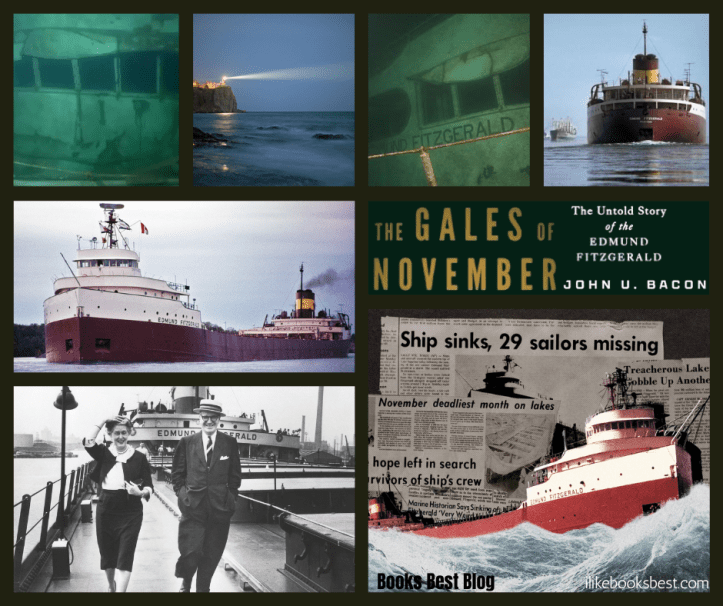
For three decades following World War II, the Great Lakes overtook Europe as the epicenter of global economic strength. The region was the beating heart of the world economy, possessing all the power and prestige Silicon Valley does today. And no ship represented the apex of the American Century better than the 729-foot-long Edmund Fitzgerald—the biggest, best, and most profitable ship on the Lakes.
But on November 10, 1975, as the “storm of the century” threw 100 mile-per-hour winds and 50-foot waves on Lake Superior, the Mighty Fitz found itself at the worst possible place, at the worst possible time. When she sank, she took all 29 men onboard down with her, leaving the tragedy shrouded in mystery for a half century.
In The Gales of November, award-winning journalist John U. Bacon presents the definitive account of the disaster, drawing on more than 100 interviews with the families, friends, and former crewmates of those lost. Bacon explores the vital role Great Lakes shipping played in America’s economic boom, the uncommon lives the sailors led, the sinking’s most likely causes, and the heartbreaking aftermath for those left behind—”the wives, the sons, and the daughters,” as Gordon Lightfoot sang in his unforgettable ballad.
Focused on those directly affected by the tragedy, The Gales of November is both an emotional tribute to the lives lost and a propulsive, page-turning narrative history of America’s most-mourned maritime disaster.
A Definitive Account of the Edmund Fitzgerald Disaster
The following ratings are out of 5:
Story/Plot: 📕📗📙📘📔
World building: 🌏🌍🌎🌏🌏
Character development: 😋😀😛😟😮
Narration: 🎙🎙🎙🎙
Narration Type: Solo Narration
Character Backgrounds
Because The Gales of November: The Untold Story of the Edmund Fitzgerald is nonfiction, its “characters” are real people rather than fictional creations—but they are developed with remarkable depth. I read this book because I am from Minnesota and feel some sort of connection with this tragedy which happened when I was just a little girl. I remember taking vacations to Duluth and reading about the disaster so much which happened around that time in my life.
John U. Bacon brings the 29 crew members of the SS Edmund Fitzgerald to life through personal histories, family perspectives, and accounts from fellow sailors. These men are portrayed as hardworking, experienced individuals who faced the physical and emotional demands of life on the Great Lakes. Their time away from home, the risks of their profession, and their tight-knit camaraderie are all explored in a way that makes their loss deeply personal.
The ship itself also takes on a symbolic role, representing industrial strength and pride. Bacon further enriches the narrative by including voices from families, investigators, and others connected to the tragedy, creating a broad and emotionally grounded portrait.
Plot Summary
The audiobook unfolds in a layered, documentary-style format, blending historical context with the events leading up to the tragedy.
It begins by exploring the rise of Great Lakes shipping after World War II, establishing the Edmund Fitzgerald as one of the largest and most respected freighters of its time. Bacon paints a vivid picture of the shipping industry—its economic importance, its demanding pace, and the inherent dangers sailors faced on a daily basis.
As the narrative progresses, the focus shifts toward the culture of lake freighters, including the pressures placed on crews and the potential safety concerns that may have played a role in the disaster.
The tension steadily builds as the story approaches November 10, 1975. On that day, the Edmund Fitzgerald set out across Lake Superior despite worsening weather conditions. What follows is a gripping reconstruction of the ship’s final voyage, as the storm intensifies with massive waves and brutal winds.
Communication from the ship becomes increasingly sparse until it abruptly ceases. Without sending a distress signal, the Edmund Fitzgerald disappears beneath the surface, taking all 29 crew members with it.
The aftermath examines the investigation into the sinking, the competing theories about what went wrong, and the enduring grief experienced by the families. Bacon also reflects on how this tragedy marked the end of an era for Great Lakes shipping and left behind one of the most enduring maritime mysteries in American history.
Highlights and Limitations
Highlights
• Thorough research and realism: The level of detail adds authenticity and emotional weight to the story.
• Human focus: By centering the crew and their families, the book becomes more than just a disaster account.
• Compelling final act: The reconstruction of the last voyage is tense, immersive, and deeply affecting.
• Historical depth: The broader look at Great Lakes shipping adds richness and context.
Limitations
• Heavy detail: Some listeners may find the historical and technical sections slow or dense.
• Large number of people: It can be challenging to keep track of all the individuals introduced.
• Slow buildup: The most dramatic portion occurs later in the audiobook, which may not suit those looking for immediate action.
Narration Review
Johnny Heller delivers a strong and fitting performance for this type of material. His voice carries a natural gravitas that complements the seriousness of the subject matter.
He handles the technical and historical sections with clarity, making them easier to follow, and shifts tone effectively during the more emotional and intense moments. In the final chapters, his delivery becomes especially impactful, underscoring the tragedy without feeling overly dramatic.
Overall, the narration is steady, respectful, and engaging, enhancing the listening experience without overshadowing the story itself.
Final Opinion
The Gales of November is a deeply moving and meticulously crafted audiobook that goes far beyond recounting a single disaster. It offers a full portrait of an industry, a community, and the people at the heart of a tragedy.
While it requires some patience due to its detailed buildup, the payoff is a powerful and haunting story that stays with you. For listeners who enjoy well-researched nonfiction and emotionally grounded storytelling, this audiobook is both compelling and memorable.
It stands as a meaningful tribute to the lives lost and a definitive exploration of one of the most unforgettable maritime disasters in American history.
Blog|Goodreads|Facebook|Instagram|Pinterest|BookBub
View all my reviews

