Project Hail Mary by Andy Weir
My rating: 5 of 5 stars
Ryland Grace is the sole survivor on a desperate, last-chance mission – and if he fails, humanity and the earth itself will perish.
Except that right now, he doesn’t know that. He can’t even remember his own name, let alone the nature of his assignment or how to complete it.
All he knows is that he’s been asleep for a very, very long time. And he’s just been awakened to find himself millions of miles from home, with nothing but two corpses for company.
His crew-mates dead, his memories fuzzily returning, he realizes that an impossible task now confronts him. Alone on this tiny ship that’s been cobbled together by every government and space agency on the planet and hurled into the depths of space, it’s up to him to conquer an extinction-level threat to our species.
And thanks to an unexpected ally, he just might have a chance.
Hard Science, High Stakes, and Huge Payoff
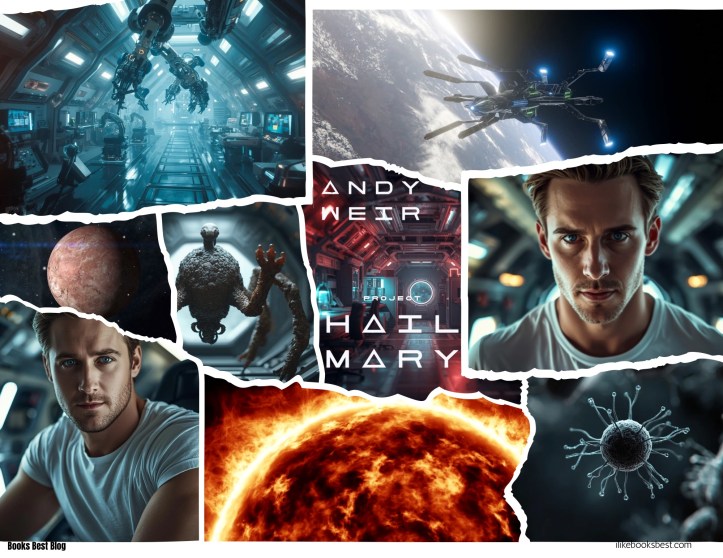
The following ratings are out of 5:
Story/Plot: 📕📗📘📙📔
World building: 🌏🌍🌎🌏🌍
Character development: 👨🏼🚀🧑🏻🚀🧑🏻🚀🧑🏻🚀🧑🏻🚀
Narration: 🎙🎙🎙🎙🎙
Narration Type: Solo Narration
🎧 Audiobook Review: Project Hail Mary
Author: Andy Weir
Genre: Science Fiction
Narrator: Ray Porter
📚 Character Background and Plot Dynamics
Ryland Grace wakes in a haze of exhaustion, unable to answer even the simplest question from the computerized voice monitoring him. His body feels foreign, his voice barely works, and his surroundings—sterile, mechanical, and eerily quiet—offer no clues. As he forces his eyes open, he sees robotic arms, unfamiliar equipment, and two other beds whose occupants he can’t quite make out. Nothing feels right, and worst of all, he has no memory of who he is.
As fragments of memory begin to surface, Grace discovers unsettling truths: the other two people in the room have been dead for some time, his body is inexplicably strong, and he’s not in a hospital at all. Slowly, painfully, he pieces together his identity and the crisis he was part of before everything went dark.
He remembers the Petrova Problem—the terrifying discovery that the sun is losing energy—and his unexpected role in humanity’s desperate attempt to solve it. Once a junior high science teacher with a background in microbiology, Grace had written a controversial paper that ultimately placed him on the team tasked with saving Earth. Now he realizes he’s aboard a spacecraft called the Hail Mary, and he may be the last person capable of completing the mission.
The slow return of his memories mirrors the story’s central tension: a man alone, trying to understand not just where he is, but why he’s there—and what he must do next.
🌟 Strengths
• Flashbacks that elevate the story. I’m not usually a fan of flashbacks, but here they’re essential. They echo Grace’s disorientation and rebuild his past in a way that feels natural, emotional, and deeply human.
• A story that grabs you immediately. I finally picked this up because the movie is coming soon, and within minutes I was hooked. The pacing, the mystery, and the scientific intrigue make it incredibly hard to stop listening.
• Science that feels real. The technical detail is outstanding. Grace’s experiments with Astrophage are described with such clarity and authenticity that they feel like genuine scientific problem‑solving rather than hand‑waving sci‑fi.
• Grace and Rocky’s communication. Their interactions are clever, heartfelt, and often surprisingly funny. It’s one of the most memorable relationships I’ve encountered in sci‑fi, and I cannot wait to see how the film adapts it.
• A rare “I don’t want this to end” experience. I enjoy many books, but it’s uncommon for me to repeatedly think about how much I’m loving something while I’m still in the middle of it. This audiobook absolutely gave me that feeling.
• Global cooperation done right. I love stories where humanity sets aside differences to face a shared threat. It’s hopeful, uplifting, and a reminder of what people can accomplish together.
• Genuinely funny moments. The humor—especially the oversharing science officers—adds levity without undercutting the stakes.
💔 Limitations
• Grace’s low self‑esteem. The only drawback for me was how often Grace downplayed his own importance in the flashbacks. While it fits his personality, it occasionally felt at odds with how crucial he clearly was to the mission.
🎙️ Narration
Ray Porter narrates the audiobook, and given the hype I’d seen on Goodreads and TikTok, my expectations were high. Overall, he delivers a strong, engaging performance. His voice suits Grace perfectly—warm, grounded, and capable of shifting between excitement, sarcasm, and quiet determination.
I wasn’t as fond of his interpretation of the female voices, and I still wish major sci‑fi releases would embrace duet or full‑cast narration. With a story this dynamic, it feels like a missed opportunity. Still, Porter’s performance absolutely enhances the experience, and I’m glad I chose the audio format.
💬 Final Assessment
Project Hail Mary is everything I want in science fiction: inventive, emotional, funny, and grounded in real scientific curiosity. It balances high‑stakes tension with genuine heart, and Ryland Grace is the kind of protagonist who lingers with you long after the final chapter. The audiobook is immersive, the story is unforgettable, and the blend of science and humanity is pitch‑perfect.
This is an easy five‑star listen—one of those rare books that reminds you why you love stories in the first place.
💭 Quotes
“I think my job is to solve the Petrova problem.
…in a small lab, wearing a bedsheet toga, with no idea who I am, and no help other than a mindless computer and two mummified roommates.”
“This isn’t Vulcans dropping by to say hi. This is space algae.”
“Astrophage—the word alone that makes all my muscles clench up. A chilling terror that hits like a lead weight.
That’s the name.
The thing that threatens all life on Earth.
Astrophage.”
“So I’m a single man in my thirties, who lives alone in a small apartment, I don’t have any kids, but I like kids a lot. I don’t like where this is going…
A teacher! I’m a schoolteacher! I remember it now!
Oh, thank God. I’m a teacher.”
“I penetrated the outer cell membrane with a nanosyringe.”
“You poked it with a stick?”
“No!” I said. “Well. Yes. But it was a scientific poke with a very scientific stick.”
Blog|Goodreads|Facebook|Instagram|Pinterest|BookBub
View all my reviews
 Books Best Blog