Origin by Dan Brown
My rating: 4 of 5 stars
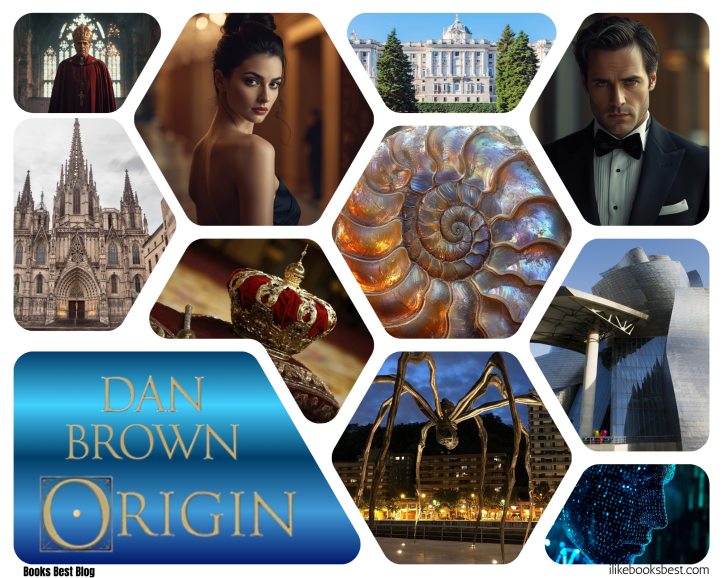
Robert Langdon, Harvard professor of symbology and religious iconology, arrives at the ultramodern Guggenheim Museum Bilbao to attend a major announcement – the unveiling of a discovery that “will change the face of science forever.” The evening’s host is Edmond Kirsch, a forty-year-old billionaire and futurist whose dazzling high-tech inventions and audacious predictions have made him a renowned global figure. Kirsch, who was one of Langdon’s first students at Harvard two decades earlier, is about to reveal an astonishing breakthrough… one that will answer two of the fundamental questions of human existence.
As the event begins, Langdon and several hundred guests find themselves captivated by an utterly original presentation, which Langdon realizes will be far more controversial than he ever imagined. But the meticulously orchestrated evening suddenly erupts into chaos, and Kirsch’s precious discovery teeters on the brink of being lost forever. Reeling and facing an imminent threat, Langdon is forced into a desperate bid to escape Bilbao. With him is Ambra Vidal, the elegant museum director who worked with Kirsch to stage the provocative event. Together they flee to Barcelona on a perilous quest to locate a cryptic password that will unlock Kirsch’s secret.
Navigating the dark corridors of hidden history and extreme religion, Langdon and Vidal must evade a tormented enemy whose all-knowing power seems to emanate from Spain’s Royal Palace itself… and who will stop at nothing to silence Edmond Kirsch. On a trail marked by modern art and enigmatic symbols, Langdon and Vidal uncover clues that ultimately bring them face-to-face with Kirsch’s shocking discovery… and the breathtaking truth that has long eluded us. Origin is stunningly inventive – Dan Brown’s most brilliant and entertaining novel to date.
A Thought‑Provoking Return to Langdon’s World
The following ratings are out of 5:
Story/Plot: 📕📗📘📙
World building: 🌏🌍🌎🌏🌍
Character development: 😋😀😍😎
Narration: 🎙🎙🎙🎙
Narration Type: Solo Narration
🎧 Audiobook Review: Origin (Robert Langdon, #5)
Author: Dan Brown
Genre: Thriller
Narrator: Paul Michael
📚 Character Background and Plot Dynamics
Robert Langdon, Harvard professor of symbology and religious iconography, finds himself once again swept into a high-stakes mystery—this time in Spain. He’s been summoned by his former student, the brilliant and eccentric billionaire futurist Edmund Kirsch. Known for his groundbreaking work in game theory and computer modeling, Kirsch claims to have made a discovery that answers two of humanity’s oldest questions: Where do we come from? and Where are we going? A revelation he believes will upend the world’s major religions.
Kirsch’s invitation is cryptic, and his behavior leading up to the event even more so. A year earlier, he had approached Langdon with uncharacteristic curiosity about God and religion, only to vanish again until sending a plane ticket and a promise that the trip would be “worth his while.”
Before the big reveal, Kirsch confides in Langdon that he fears for his life. After consulting with three spiritual leaders at the Abbey of Montserrat, he believes his discovery threatens powerful institutions—particularly Bishop Valdespino, who left him a menacing voicemail. Kirsch hands Langdon a mysterious business card encoded with a cipher, instructing him to use it after the announcement.
But the unveiling never happens. As Ambra Vidal—the poised museum director and fiancée of Spain’s crown prince—introduces the event, Kirsch appears onstage only to be assassinated before he can reveal his discovery. The attack is broadcast live to millions, thrusting Ambra into a political firestorm in a deeply Catholic nation.
Refusing to retreat into safety, Ambra joins Langdon in a desperate race to honor Kirsch’s final wishes. Together, they slip past her security detail and head to Barcelona, determined to uncover the truth Kirsch died trying to share.
🌟 Strengths
• Rich, immersive world-building. Dan Brown’s descriptions of the Guggenheim Museum in Bilbao—its architecture, atmosphere, and iconic fog installation—are vivid and cinematic. His character descriptions are equally sharp, making each figure easy to visualize.
• A welcome return to the Langdon universe. Revisiting Brown’s blend of art, science, religion, and intellectual puzzles brought back the excitement of reading The Da Vinci Code and Angels & Demons for the first time.
• Complex, layered antagonists. Brown excels at giving villains depth. Admiral Ávila initially appears sympathetic, even admirable, before revealing the zealotry driving his actions.
• Ambra’s complicated relationship with Prince Julián. Her uncertainty about his motives adds emotional tension and keeps the reader guessing.
• Winston, the AI docent. The integration of an AI assistant into the narrative is clever, entertaining, and thematically relevant—especially in a story centered on technology’s collision with faith.
• Fascinating research woven throughout. From scientific experiments to art, poetry, and philosophy, Brown’s meticulous research adds intellectual texture and sparks curiosity.
• A continued exploration of science vs. religion. This thematic thread remains one of the series’ strongest elements, and Origin leans into it with modern urgency.
💔 Limitations
• A noticeably slower middle section. Compared to the relentless pacing of Angels & Demons or the puzzle-driven momentum of The Da Vinci Code, Origin feels more measured—sometimes to its detriment. The tension simmers rather than sprints.
• Too many POV shifts. While the multiple perspectives offer a broad view of unfolding events, they also fragment the narrative. The constant switching made the story feel disjointed at times, and I found myself wishing for more sustained focus on Langdon and Ambra’s discoveries.
• Engagement dips. Even at increased audiobook speed, the middle stretch dragged enough that I set it aside more than once.
🎙️ Narration
Paul Michael delivers a strong, polished performance. His deep, precise voice suits the tone of the story, and he handles accents, languages, and character differentiation with skill. His narration adds clarity and gravitas, especially during the more technical or philosophical passages.
💬 Final Assessment
Origin is an ambitious, intellectually engaging addition to the Robert Langdon series—one that blends art, science, religion, and technology into a sleek modern thriller. While the pacing falters and the shifting perspectives occasionally dilute the tension, the novel’s atmospheric settings, intriguing characters, and thought-provoking themes make it a compelling read. It may not reach the exhilarating heights of Brown’s earlier works, but it still offers a satisfying mystery with a timely, unsettling twist that lingers long after the final chapter.
If you’re drawn to stories that challenge belief systems, explore the intersection of faith and innovation, and deliver a blend of suspense and cerebral intrigue, Origin is well worth the listen.
💭 Quotes
“Historically, the most dangerous men on earth were men of God…especially when their gods became threatened.”
“Imagine walking yourself down a long hallway—a corridor so long that it is impossible to see where you came from or where you’re going. Then behind you in the distance you hear the sound of a bouncing ball. Sure enough, when you turn, you see the ball bouncing toward you. It is bouncing closer and closer, until it finally bounces past you, and just keeps going, bouncing into the distance and out of sight.” The question is not: Is the ball bouncing? Because clearly it is bouncing, and we observe it. The question is: Why is it bouncing? How did it start bouncing? Did someone kick it? Is it a special ball that simply enjoys bouncing? Are the laws of physics in this hallway such that the ball has no choice but to bounce forever? Where is the ball going?”
“Well, science and religion are not competitors, they’re two different languages trying to tell the same story. There’s room in this world for both.”
“My friends, I am not saying I know for a fact that there is no God. All I am saying is that if there is a divine force behind the universe, it is laughing hysterically at the religions we’ve created in an attempt to define it.”
“And history has proven repeatedly that lunatics will rise to power again and again on tidal waves of aggressive nationalism and intolerance, even in places where it seems utterly incomprehensible.”
Blog|Goodreads|Facebook|Instagram|Pinterest|BookBub
View all my reviews
 Books Best Blog