Remain by Nicholas Sparks
My rating: 5 of 5 stars
When New York architect Tate Donovan arrives in Cape Cod to design his best friend’s summer home, he is hoping to make a fresh start. Recently discharged from an upscale psychiatric facility where he was treated for acute depression, he is still wrestling with the pain of losing his beloved sister. Sylvia’s deathbed revelation—that she can see spirits who are still tethered to the living world, a gift that runs in their family—sits uneasily with Tate, who struggles to believe in more than what reason can explain. But when he takes up residence at a historic bed-and-breakfast on the Cape, he encounters a beautiful young woman named Wren who will challenge every assumption he has about his logical and controlled world.
Tate and Wren find themselves forging an immediate connection, one that neither has ever experienced before. But Tate gradually discovers that below the surface of Wren’s idyllic small-town life, hatred, jealousy, and greed are festering, threatening their fragile relationship just as it begins to blossom. Tate realizes that in order to free Wren from an increasingly desperate fate, he will need to unearth the truth about her past before time runs out . . . a quest that will make him doubt whether we can ever believe the stories we tell about ourselves, and the laws that govern our existence. Love—while transformative—can sometimes be frightening.
A story about the power of transcendent emotion, Remain asks us: Can love set us free not only from our greatest sorrows, but even from the boundaries of life and death?
Healing and Haunting in Heatherington
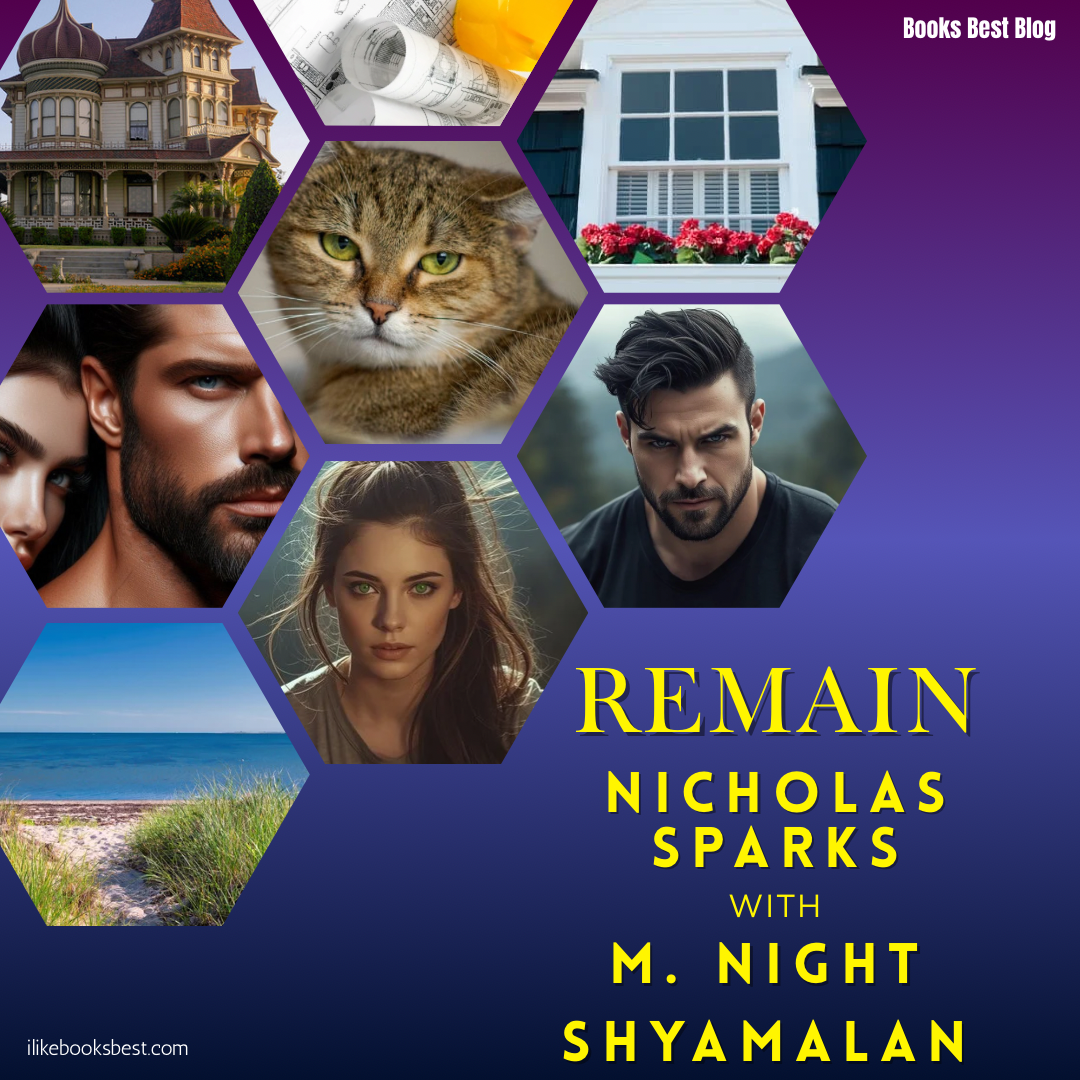
The following ratings are out of 5:
Romance: 💙💜💚❤️🤎
Heat/Steam: 🔥🔥
Chemistry: 🧪🧪🧪🧪
Story/Plot: 📕📗📘📙📔
World building: 🌏🌍🌎🌏🌍
Character development: 😋😀😛😘🥰
Narration: 🎙🎙🎙🎙🎙
Narration Type: Dual Narration
🎧 Audiobook Review: Remain
Author: Nicholas Sparks and M. Night Shyamalan
Genre: Paranormal Romance
Narrators: Ari Fliakos & Julia Whelan
The novel introduces Tate Donovan, a thirty‑eight‑year‑old architect attempting to rebuild his life after a period of profound personal loss. His move to the bustling Cape Cod town of Heatherington—initially a straightforward work trip to design a home for his longtime friend Oscar—quickly becomes a catalyst for emotional and psychological upheaval. Tate’s privileged upbringing and complicated family history establish him as a character shaped as much by absence as by affluence, and the narrative uses his return to a small coastal community to explore themes of grief, identity, and the limits of rationality.
Tate’s recent stay in a psychiatric hospital and his exposure to DBT (Dialectical Behavior Therapy) provide a grounded counterpoint to the story’s supernatural undercurrents. His sister Sylvia’s final revelations about their family’s ability to see spirits blur the line between psychological distress and paranormal inheritance. The book uses Tate’s flickering peripheral visions not merely as eerie embellishments but as a device to interrogate how trauma alters perception—and how belief can become both a comfort and a destabilizing force.
Parallel to Tate’s journey is Wren, a local innkeeper whose life has been shaped by her own quiet battles. Her grief, isolation, and faltering confidence create a portrait of someone who is outwardly capable yet internally adrift. The pandemic’s impact on her business and relationships adds a contemporary layer that feels emotionally authentic, even when her timeline becomes difficult to track. Her connection with Tate forms the emotional core of the story, though the extended focus on their early interactions occasionally slows the pacing.
The novel’s blend of supernatural mystery and romantic tension evokes the atmospheric storytelling of M. Night Shyamalan, while the emotional stakes and tragic undertones echo the sensibilities of Nicholas Sparks. This combination creates a narrative that is both suspenseful and tender, with an ending that resists predictability even when certain twists can be anticipated.
The audiobook’s dual narration enhances the experience. Ari Fliakos brings a textured, slightly gravelly tone to Tate’s perspective without overplaying female voices, while Julia Whelan delivers a warm, steady performance that suits Wren’s introspective nature. Their contrasting styles help delineate the characters’ inner worlds and maintain engagement throughout.
This story succeeds in weaving together grief, romance, and the supernatural into a compelling, emotionally layered narrative. While some structural elements—particularly Wren’s timeline and the prolonged early character bonding—can feel uneven, the novel’s atmosphere, character depth, and thematic ambition make it a rewarding experience. The audiobook narration further elevates the material, offering a thoughtful and immersive interpretation of the dual perspectives.
Blog|Goodreads|Facebook|Instagram|Pinterest|BookBub
View all my reviews
 Books Best Blog